When the Designer Becomes a Translator Between Humans and Systems
As AI gets smarter, we’re talking more and more about systems.
Agents. Predictions. Automation. Intent. Generative UI. somewhere in all of that, it’s easy to forget one thing:
At the end of the day, we’re still designing for people.
And people are not APIs.
They don’t always know how to articulate exactly what they want.They change their minds, take shortcuts, make mistakes, leave things out, and communicate in natural, unstructured ways. AI is learning to operate within exactly that gray area.
In the past, users had to learn the language of the system: where to search. which filter to choose. which field to fill in. and in what order to complete each step. Today, that expectation is starting to reverse.
The user no longer wants to learn the system’s language.
They expect the system to learn theirs.
They type the way they think, ask the way they speak, and expect a clear, accurate, relevant response.
And not just a response. They’re beginning to expect the system to understand context, fill in what wasn’t said, and anticipate what they’re likely to want to do next. This is where our role as designers actually becomes more human.
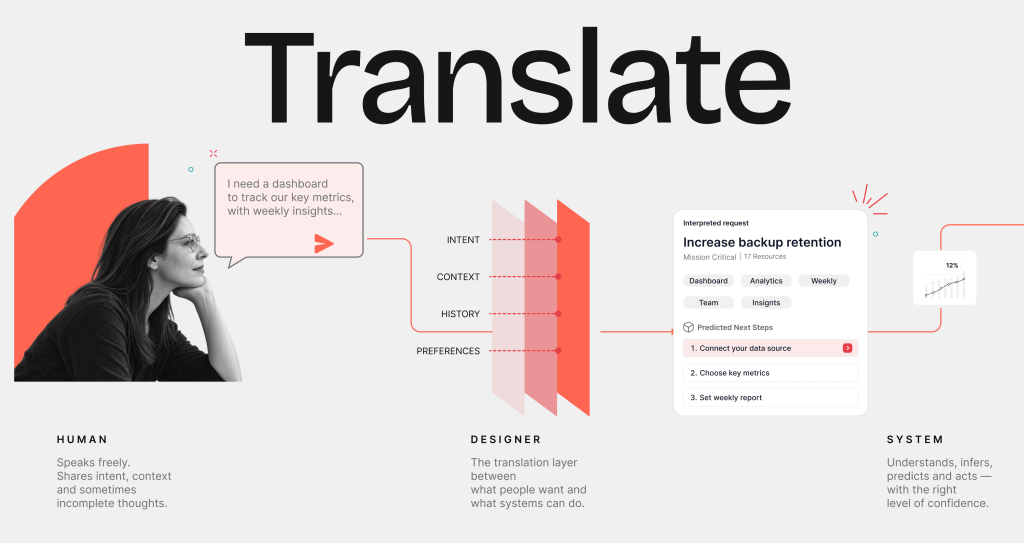
We’re becoming translators between people and systems.
On one side, we need to understand the user: what are they really trying to achieve? what haven’t they said?
where are they uncertain? what will make them trust the result?
And what are they likely to want next? On the other side, we need to understand the system: what does it actually know? what is it only inferring? how confident is it? what should it be allowed to do on its own? and when should it simply say: I don’t know.
This also changes the way we think about the User Journey. we used to design the sequence of actions a user needed to take.
Now, we also need to design the level of system involvement throughout that journey.
When should it simply understand?
When should it suggest?
When should it predict?
When should it act?
And when should it hand the decision back to the human?
Because good Predictive UX isn’t about a system that tries to predict everything.
It’s about a system that knows when it’s confident enough to help — and when it isn’t.
And maybe that’s the most interesting paradox of this moment:
The smarter our systems become,
the better we, as designers, need to understand our users.
AI is changing our tools.
It’s changing the User Journey.
It’s changing the interfaces we design.
But it isn’t taking the human out of the equation.
It’s making our understanding of people the most important part of the system.
Have something to say? Contact us and add your comments